
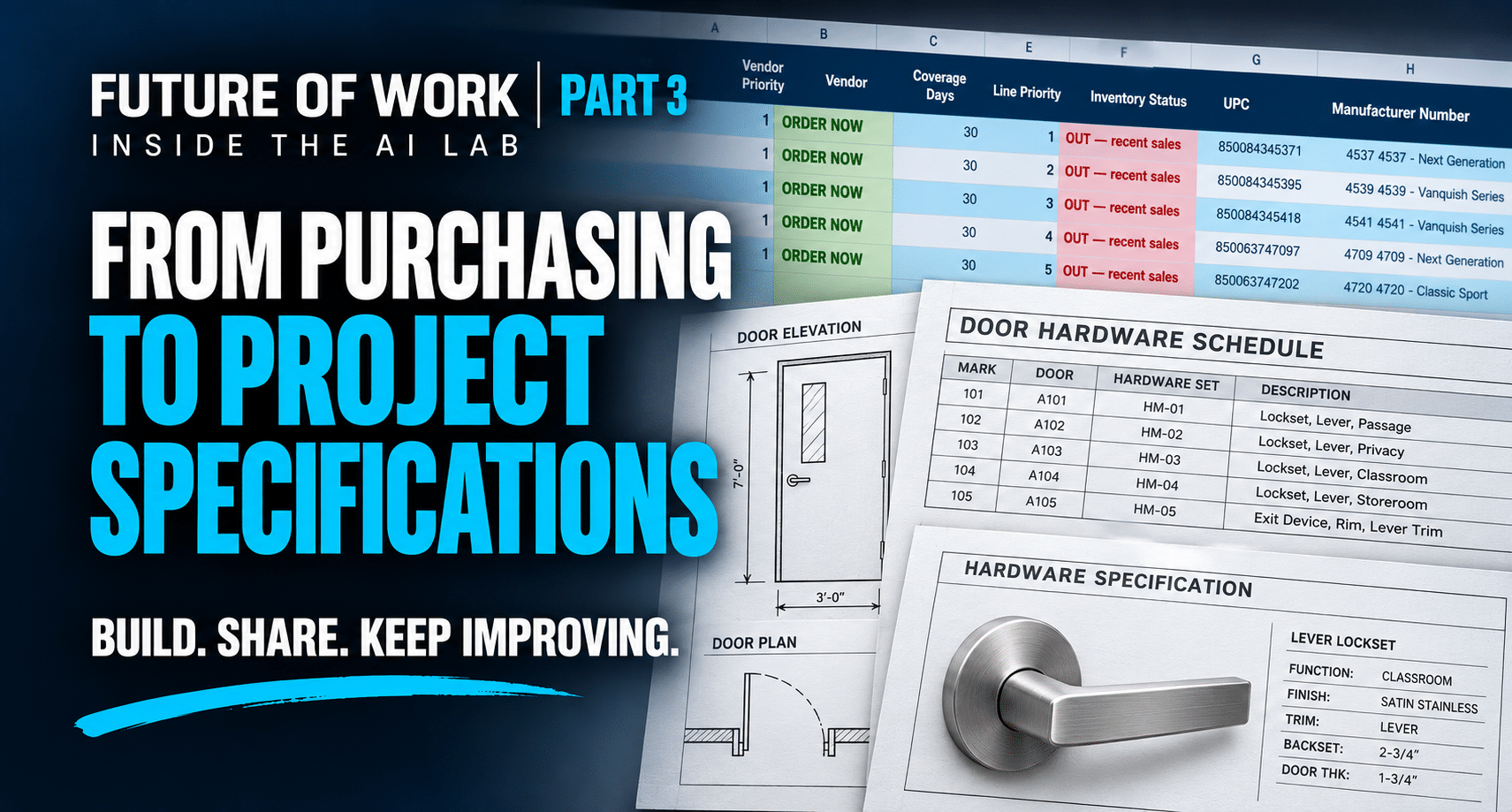
Future of Work, Part 3: From Purchasing to Project Specifications—Building AI Workflows That Keep Improving
What Order Intelligence at Sweeney’s Sports is teaching us about developing complex workflows, putting them in employees’ hands, and improving them through everyday use.
In the first installment of this series, I introduced our somewhat unconventional AI laboratory: a fishing tackle store in Napa. In Part 2, I walked through Pond Stars, the used fishing gear business we rebuilt with connected AI workflows.
Both experiments explore the same question: What happens when a small team can spend less time managing information and more time applying its expertise?
Our latest example is Order Intelligence, the purchasing system we’ve been developing at Sweeney’s Sports.
Its connection to architecture becomes clearer when you look closely at the work.
Consider preparing a Shimano order from a catalog containing thousands of products. We need to compare sales from the relevant period last year with the last 60 days, account for inventory and outstanding orders, and decide what belongs in the next purchase.
A strong seller last season may be slowing down. Something selling quickly now may already be on its way. A familiar model may have been discontinued.
Order Intelligence brings those records together and prepares a recommendation for review. Building a substantial manufacturer order previously took at least 3-4 hours, often interrupted by store responsibilities. Today, it takes about an hour, much of it spent exploring new products. Those are working estimates, but the change in how we spend that time is substantial.
Now imagine an architect selecting door hardware for a current project, drawing on experience from three similar projects.
The useful information extends beyond the manufacturer’s catalog. It includes previous hardware schedules, approved substitutions, coordination comments, and what the team learned during construction.
One project may offer a useful starting point for hardware sets. Another may reveal a coordination issue with access control. A third may document why the team changed a particular selection.
A proposed AI workflow could assemble that evidence alongside the current project’s requirements, identify candidate products, and flag differences for review. The architect would evaluate suitability and resolve the project-specific requirements.
The connection is practical:
Use past experience to narrow a vast catalog, then test the shortlist against today’s conditions.
History informs the decision. It doesn’t make it automatically.
A second comparison appears when the recommendation meets reality.
At Sweeney’s, a supplier may accept only part of an order, change a price, or offer a replacement. The final Lightspeed purchase order needs to reflect what we actually purchased. Otherwise, staff inherit discrepancies when the boxes arrive.
Previously, mismatched descriptions, duplicate product records, and damaged UPCs routinely delayed receiving. Our workflows now reconcile the confirmed order and verify the resulting records.
The architecture parallel is a hardware submittal returning after review.
Suppose the architect changes a proposed closer and adds a coordination comment before issuing the response. When the resubmittal arrives, an AI-assisted comparison should use that issued response—including the architect’s changes, as its reference.
Comparing against the original AI draft could bring back a decision the architect already rejected.
This also surfaced in our recent AIA Tri-State discussion: a useful workflow must preserve what was actually issued. In both settings, the next step depends on an accurate record of the final human decision.
A third comparison involves changes that are easy to miss individually but expensive collectively.
In retail, a supplier raises wholesale costs while shelf prices remain unchanged. Busy staff may not catch the increase, and margins gradually shrink. Bringing cost checks into purchasing has helped us address that recurring problem.
On a project, consider several proposed hardware substitutions. Each may appear reasonable in isolation. Together, they could introduce different finishes, additional coordination requirements, or lead times that affect the schedule.
A workflow could compare each proposal against the current selection and maintain a cumulative change log showing cost, availability, and unresolved coordination questions.
The team would have a clearer view of the consequences before accepting the changes.
These architecture examples describe workflows we could develop using lessons from the store. They also illustrate why our lab matters: reliable assistance requires connected information, explicit rules, review points, and a way to carry decisions forward.
Then comes the part I find most interesting: putting the workflow into someone else’s hands.
Shane, our store manager, is now using Codex. I exported the reusable skills we developed so he can work from the same instructions and checks.
That is an early step toward making the capability part of everyday operations. It also creates an opportunity for Shane’s experience to improve the process.
When he changes a recommendation, we should capture why. Was it a one-time customer request? A seasonal shift? A supplier problem? Or a weakness in our purchasing rules?
The next step is to review those observations, update the shared workflow, test the change, and make the improved version available to both of us.
An architecture firm could follow the same pattern. A project architect identifies a recurring hardware coordination issue. The team validates the lesson, adds a specific check to the workflow, and tests it on the next project. Other employees can then benefit from that experience.
This is the central lesson our lab is helping us develop:
Build the workflow, teach people to use it, and give them a practical way to improve it.
Continuous improvement needs ownership, shared instructions, and deliberate updates. It doesn’t happen simply because an AI tool was involved.
At Sweeney’s, we’re beginning to establish that cycle. Through ArchIT AI Labs, we’re learning how to bring the same discipline to complex work in architecture, so each project can contribute to a better process for the next.