
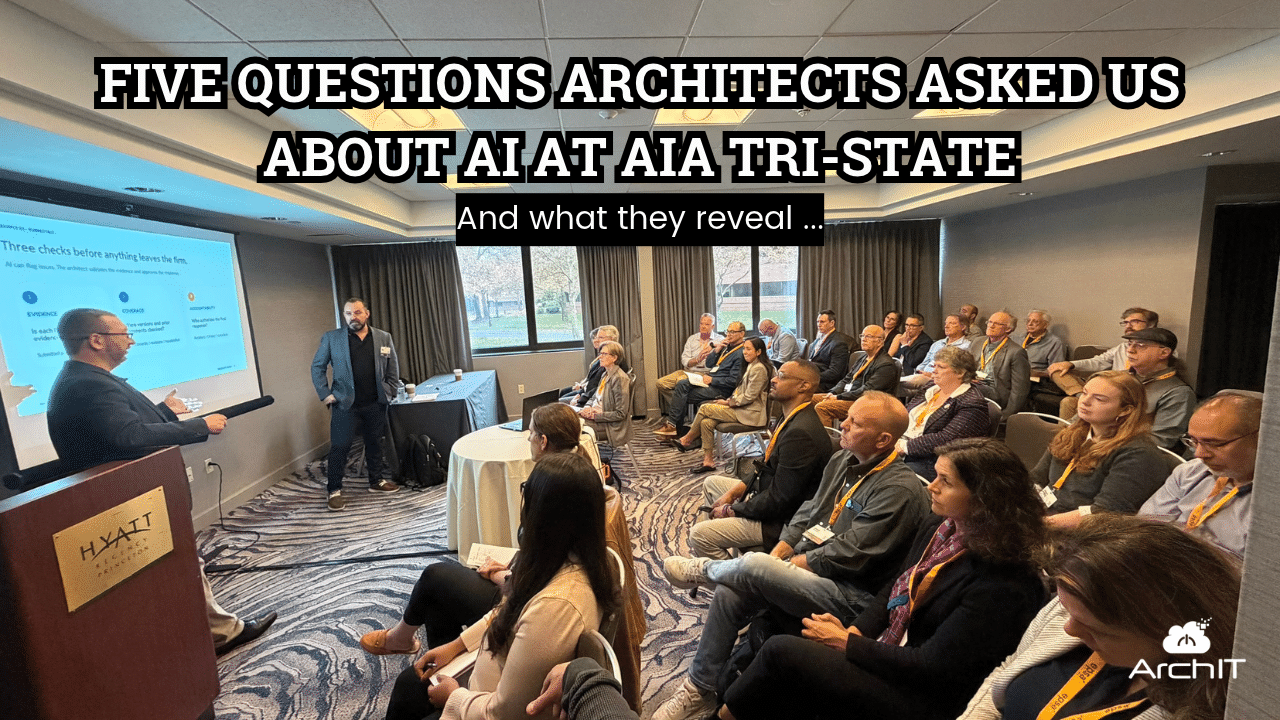
Five Questions Architects Asked Us About AI at AIA Tri-State
And what they reveal about where AI adoption in architecture is headed.
Last week, Boris Rapoport and I had the opportunity to present “AI Adoption Playbook for Small and Medium Architecture Firms” at the 2026 AIA Tri-State Conference in New Jersey.
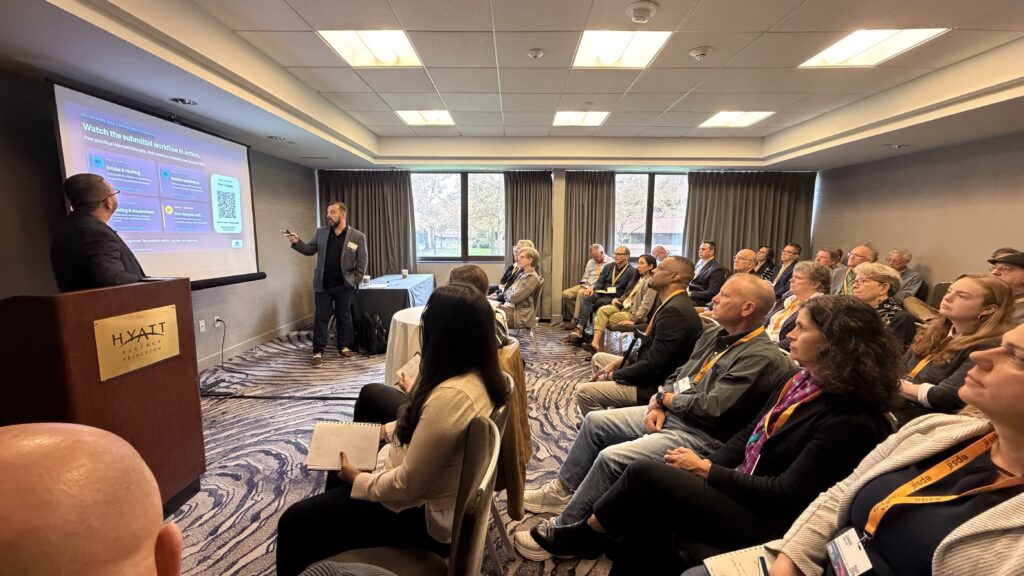
We walked into a packed room of approximately 50 attendees, with every seat taken and people standing in the back.
For 45 minutes, we explored how architecture firms can move beyond individual AI experimentation toward practical, secure, and repeatable workflows. Boris covered the technical side of implementation, while I focused on translating those capabilities into business outcomes.
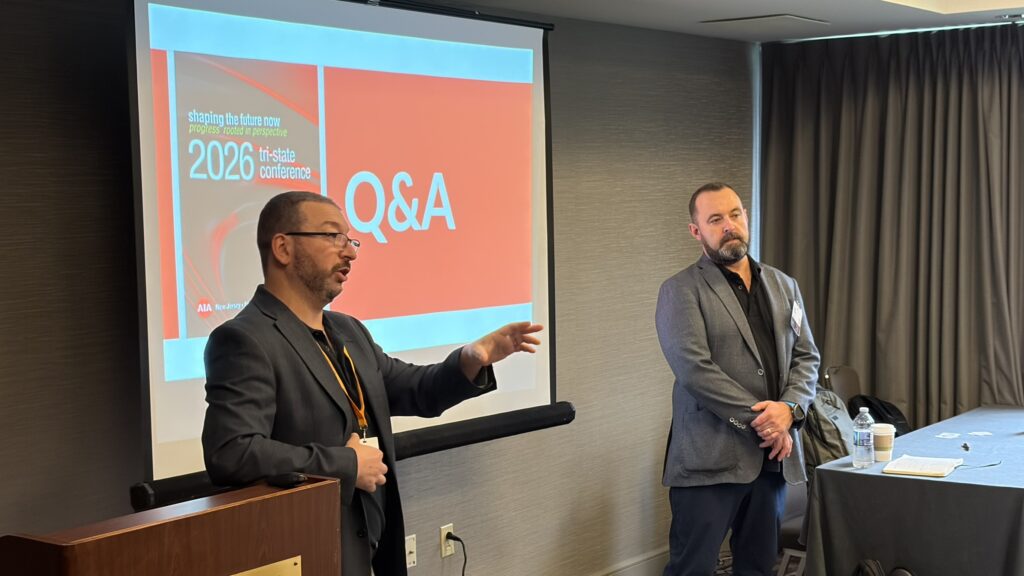
The audience was engaged throughout. But what stayed with me most wasn’t our presentation. It was the questions afterward.
We captured five particularly interesting questions from the discussion. Together, they reveal something important about where the profession stands with AI.
Architects are moving beyond “Can AI do this?”
They’re starting to ask
“How does AI fit into the way we actually practice architecture?”
That’s a much more interesting conversation.
1. Will AI know what we actually sent, rather than just what it drafted?
One attendee raised an important point about our AI-assisted submittal workflow.
Suppose AI prepares a response to a contractor. The architect reviews it, makes changes, and sends out a version that’s different from what AI originally proposed.
When that submittal comes back, shouldn’t AI know what was actually issued?
Absolutely. And this highlights a critical distinction between an AI assistant and a well-designed AI workflow.
An AI-generated draft is not necessarily the final record of what happened.
In construction administration, that distinction is particularly important.
Consider a resubmittal. To help evaluate it, AI needs access to the actual response issued by the architect, including the final markups, comments, and dispositions.
It shouldn’t rely on an earlier AI-generated draft that may have been substantially modified.
This requires more than a clever prompt. It requires a process that preserves approved documents, tracks revisions, and makes the correct records available to AI.
It also reinforces a principle we’ve emphasized throughout our AI-enabled submittal process series:
AI prepares. Humans review and decide. The approved action is executed and its result verified.
The real value comes when the workflow reliably carries that information forward.
2. Can AI review architectural drawings, shop drawings, and markups, rather than just text-based submittals?
This question reflects an understandable frustration.
Architecture is a visual profession. Our most important information isn’t always contained in paragraphs of text. It’s embedded in drawings, details, schedules, annotations, and markups.
The encouraging answer is yes: modern multimodal AI systems can analyze visual information, not just text.
They can help identify drawing notes, extract information from schedules, examine marked-up documents, and flag potential differences between documents.
Consider a shop drawing submitted for review. AI might help identify a product designation, locate related specification requirements, or highlight an apparent discrepancy for the architect to investigate.
But there’s an important limitation.
Understanding what appears on a drawing is not the same as reliably evaluating its technical correctness.
Small annotations, complex linework, drawing scales, overlapping information, and relationships between multiple sheets can challenge general-purpose AI systems.
For now, our recommendation is to introduce these capabilities through carefully defined review tasks rather than asking AI to determine whether an entire drawing package complies with the contract documents.
The architect remains responsible for professional review.
The opportunity is to reduce the searching, cross-referencing, and repetitive checking surrounding that review.
3. Does business AI protect a firm’s intellectual property?
This was one of the most consequential questions of the session.
Architecture firms possess valuable intellectual property: designs, proprietary details, specifications, internal standards, client information, and accumulated project knowledge.
Naturally, firm leaders want to know what happens when employees bring that information into AI systems.
The short answer is that business-grade AI platforms can provide substantial data protections, but those protections aren’t automatic or unlimited.
For example, OpenAI, Microsoft, and Anthropic describe commercial offerings in which customer prompts and responses are not used to train foundation models by default, subject to their applicable terms and exceptions.
That’s an important distinction from assuming every consumer AI account offers equivalent safeguards.
However, preventing model training is only one element of intellectual property protection.
Firms must also consider where information is stored, who can access it, how long it’s retained, which third-party applications can receive it, and what contractual rights apply to inputs and outputs.
Even an approved business AI platform can introduce risk if employees connect it indiscriminately to email, project files, or other systems containing sensitive information.
The right approach is not to prohibit every use of confidential information.
It’s to establish approved enterprise tools, clear data-handling rules, appropriate permissions, and project-specific restrictions.
Good governance should make responsible AI use straightforward, not unnecessarily difficult.
4. If business AI keeps our information private, how does AI continue learning?
I particularly liked this question because it gets to a fundamental misunderstanding about how modern AI works.
People often imagine that every conversation continuously teaches the underlying AI model something new.
That’s generally not how enterprise AI interactions work.
There are two distinct processes worth understanding.
Model training is how AI providers develop and improve their underlying models, using data and training methods permitted under their arrangements.
Context and retrieval allow an existing model to work with information provided during a conversation or retrieved from an authorized source.
For example, an architecture firm might provide AI with its design standards, a project specification, and examples of previous submittal reviews.
The AI can use that information to produce more relevant results without incorporating those documents into the underlying model’s training.
Meanwhile, AI providers can continue improving their models using other permitted sources, research, and eligible data-sharing arrangements.
For architecture firms, this distinction is empowering.
You don’t need to train a proprietary AI model on your firm’s information to make AI useful in your firm’s workflows.
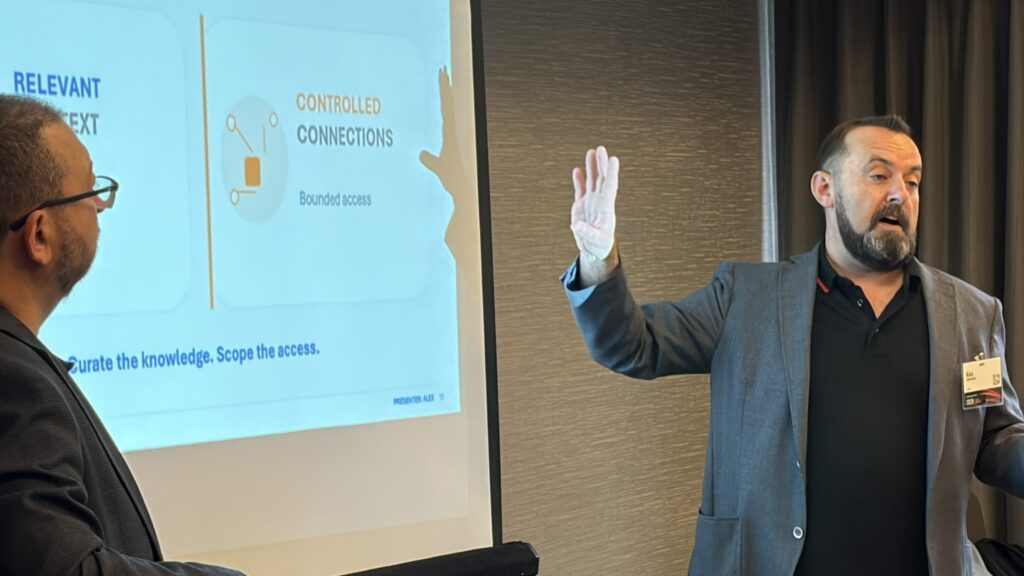
You need to give it the right context, make authoritative information available, and establish appropriate boundaries.
That’s also why we emphasize context over indiscriminately connecting every system a firm uses.
5. Can AI help review client contracts and identify missing protections?
Yes. And this may be one of the more valuable applications for architecture firm leadership.
Client agreements often contain lengthy provisions that require careful attention, particularly when the agreement is based on a client’s own contract rather than a familiar standard form.
AI can assist by comparing proposed language against a firm’s established contract-review checklist or attorney-approved provisions.
For example, it may help identify missing or unusual language involving:
- Standard of care and professional responsibilities
- Indemnification and limitation of liability
- Scope of services and additional services
- Ownership and use of instruments of service
- Payment terms, termination, and dispute resolution
Rather than asking AI whether a contract is legally safe, a better approach is to ask it to identify provisions that differ from the firm’s preferred language, explain the differences, and provide references to the relevant clauses.
That gives leadership and legal counsel a structured starting point.
Of course, AI is not an attorney. It can miss provisions, misinterpret their effect, or generate incorrect conclusions about enforceability.
The objective is a more efficient and consistent first-pass review—not replacing qualified legal advice.
This is another example of AI performing preparatory work while retaining human accountability for consequential decisions.
The Bigger Lesson: AI Adoption Is Becoming a Practice-Management Conversation
What struck me about these five questions was their practicality.
Nobody was asking us to predict when AI would replace architects.
Instead, attendees wanted to understand how AI could fit into existing workflows, preserve the integrity of project records, handle complex documents, protect valuable information, and support professional judgment.
Those are exactly the questions firms should be asking.
We believe successful AI adoption in architecture requires more than purchasing software licenses or encouraging staff to experiment.
It requires understanding how work actually gets done, identifying useful opportunities, establishing reasonable governance, and giving people the training and context needed to use AI effectively.
For smaller firms, that doesn’t have to mean a massive technology initiative.
Start with one repeatable workflow. Give AI the information it needs, not unlimited access. Establish clear human review points. Test the results, measure the improvement, and refine the process before expanding it.
Our goal at ArchIT has always been to help architects spend less time on repetitive administrative work and more time practicing architecture.
After our experience at AIA Tri-State, I’m encouraged by the direction of the conversation.
The most promising sign of AI maturity isn’t that firms are asking fewer questions. It’s that they’re starting to ask better ones.
— Alex Osenenko
Alex Osenenko is Co-Founder and Head of AI Labs at ArchIT, an IT and AI services firm specializing in architecture, design, and engineering practices.