
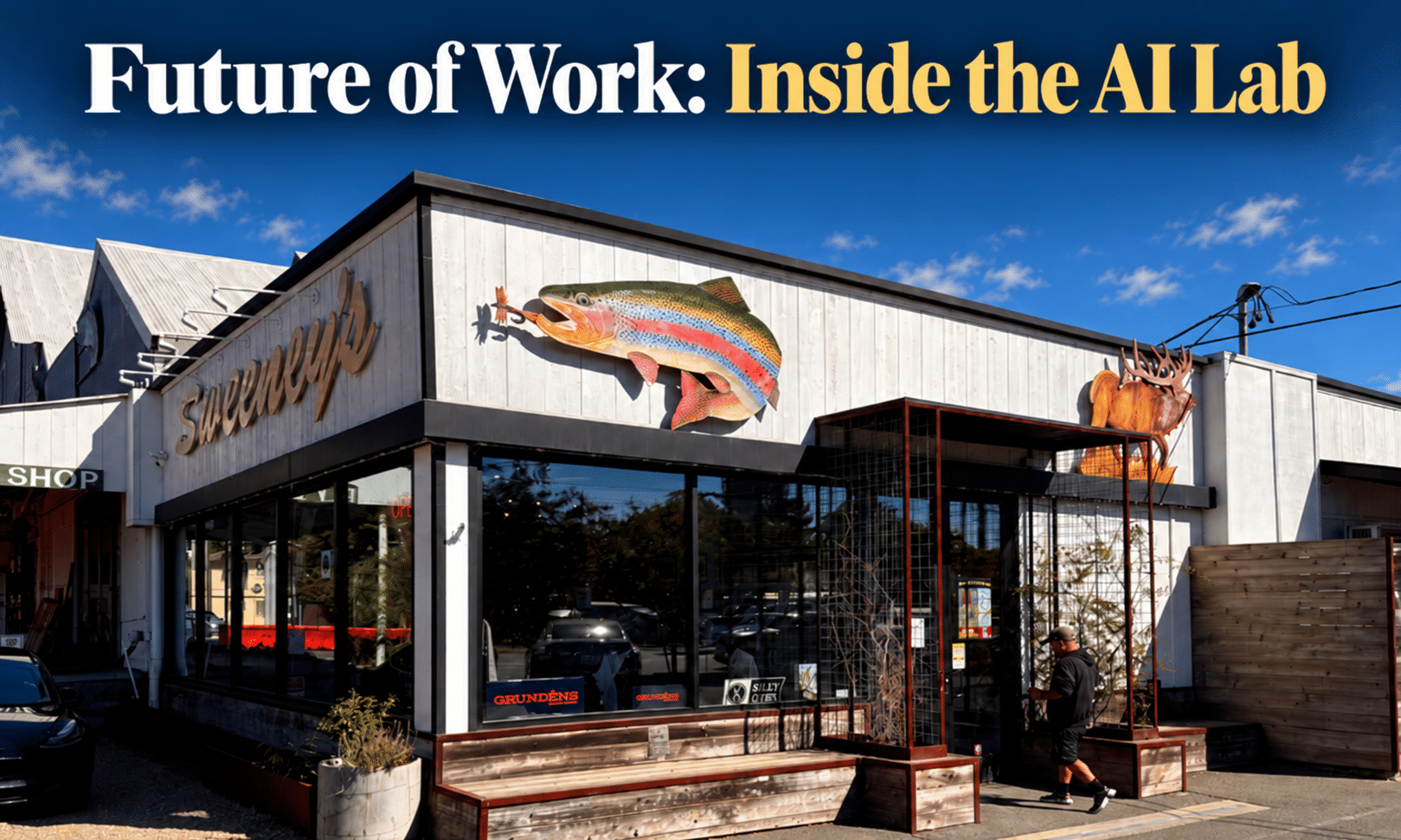
The Future of Work Is Already Here. It’s Running a Fishing Store.
How AI is helping a 56-year-old retail business reverse years of decline—and fundamentally change how its people work.
By Alex Osenenko | ArchIT Future of Work Series — Episode 1
For the past ten months, I’ve been spending a lot of time in the lab.
As Co-Founder and Head of AI Labs at ArchIT, I’ve been exploring how artificial intelligence can fundamentally change the way businesses operate and, more importantly, the nature of work itself.
But my laboratory isn’t quite what you might imagine.
It’s a fishing tackle store in Napa, California.
Besides my ArchIT work, I also own Sweeney’s Sports, a traditional retail business with real employees, real customers, thousands of products to manage, and all the operational challenges that come with running a small business.
And that makes it a pretty interesting place to experiment.
In January 2026, I began putting Codex and ChatGPT to work with a simple objective: Save a struggling business from closure and bring it back to profitability.
This wasn’t a theoretical exercise or a controlled demonstration. Every experiment had to work in a real operating business, where mistakes have consequences and the results ultimately show up in the financial statements.
It took months of building, testing, and improving workflows before we began seeing meaningful changes.
But eventually, something interesting started happening.
The nature of our work began to change.
And the early business results are getting interesting, too.
In the third quarter of 2026, our business grew revenue by 21.3% compared with the same period last year. Gross margin improved by 4.7 percentage points, and adjusted net profit reached nearly $25,000.
But here’s the number that really caught my attention.
Our customer purchase count increased by just 1.7%, while net sales per purchase grew by 12.3%.
We weren’t simply processing significantly more transactions. We were generating more value from the business we were already doing.
There are several reasons for that improvement, including an expanding used-gear program, better customer service, improved inventory management, and a strong fishing season.
But behind those developments is a much bigger story about artificial intelligence, operational efficiency, and the changing nature of work.
And it starts with a business that needed to change.
A 56-Year-Old Business Facing a Familiar Problem
Sweeney’s Sports has been part of the Napa community since 1970.
I purchased the business six years ago. It’s a traditional specialty retailer, with fishing rods, reels, tackle, live bait, and a team of people who know a great deal about fishing.
By 2022, however, the business had begun a gradual year-over-year decline.
There wasn’t one dramatic event responsible for it. We were simply struggling with the familiar challenges of operating a small retail business in a changing environment.
Too many administrative responsibilities. Too much time managing inventory. Too many processes requiring manual attention. Sluggish economy along with big box and online retailers eating into our demand and margins.
We manage approximately 26,000 product SKUs, many of them highly seasonal. Every product requires decisions about purchasing, stocking, pricing, replenishment, and eventually discontinuation or markdown.
The administrative workload is substantial.
At the beginning of 2026, we set ourselves a relatively simple objective:
Spend a lot less time managing inventory and back-office operations, and a lot more time serving customers.
We began using OpenAI’s Codex and ChatGPT to help us redesign how the business operates.
What followed wasn’t an overnight transformation. It took months of building, testing, refining, and sometimes rebuilding workflows.
But as we gradually solved more of the operational problems, something else began happening.
Our jobs started changing.
The Numbers: Q3 2025 vs. Q3 2026
Before getting into what changed, let’s look at the financial results.
The following figures come from a comparison of our third-quarter business performance using Codex to analyze financial and transaction data from our Quickbooks and Lightspeed POS systems.

What stands out is that revenue grew much faster than expenses, while gross margin improved considerably.
Our Q3 2026 adjusted net profit was approximately $24,767 Vs. -$2,995 for the same period last year.
That’s a meaningful development for a business that has spent years struggling to establish any sort of profitability.
But the most interesting question isn’t simply how much the numbers improved.
It’s why.
I see three major contributors, each connected in some way to how we’ve been changing our work.
1. Pond Stars: A New Business That Would Be Difficult to Run Without AI
One of the most significant contributors to our recent growth has been Pond Stars, our used fishing gear buying and resale program.
Customers bring us rods, reels, and collections of fishing equipment. We evaluate the gear, make offers, and resell it through the store and online.
The program has developed into an important driver of sales and customer traffic.
People are coming to Sweeney’s specifically because we buy and sell used equipment. Some travel considerable distances to bring us their collections or see what we have available.
It has created a new reason for people to visit the store, expanded our assortment, and opened up an entirely different opportunity for serving the fishing community.
But here’s the interesting part.
I don’t believe we could operate Pond Stars at its current pace without AI-supported workflows.
Unlike traditional retail inventory, used equipment doesn’t arrive in neat cartons with standardized vendor catalogs and pricing.
Every collection is different. Each item requires research, evaluation, pricing decisions, and processing before it becomes available for sale.
Some products are decades old. Others are nearly new. Sometimes we encounter equipment we’ve never seen before.
All of this creates an enormous amount of work.
AI helps us manage the information, research, and repeatable operational tasks involved. It allows us to handle a volume and variety of used gear that would otherwise be difficult to sustain with our small team.
Pond Stars is an important example of something I want to explore throughout this series.
AI isn’t simply helping us do existing work faster.
It’s helping make new business opportunities operationally possible.
We’ll dedicate an upcoming installment to Pond Stars, including how the process works, its economics, and how AI supports it.
For now, the important takeaway is that the program has become a meaningful contributor to our growth—and an example of how automation can help create revenue, not just reduce expenses.
2. From Transactions to Conversations
The second change is less technological, but potentially just as important.
We’re spending more time talking with customers.
That might sound obvious for a retail business. Of course we should spend time with customers.
But anyone who has operated a small business knows the difference between understanding what should be done and actually having time to do it.
When you’re juggling purchase orders, inventory problems, reports, accounting, and daily operations, it’s easy to become transactional.
A customer comes in, picks something off the shelf, pays, and leaves.
But when you have more time, you can stop and ask a simple question:
“What are you fishing for?”
Suddenly, the interaction changes.
Maybe the customer is headed to Lake Berryessa for trout. Maybe they’re preparing for a striper trip on the Napa River. Maybe they’re getting their child ready for a first fishing adventure.
Instead of simply ringing up a lure, we can discuss techniques, recommend equipment, solve problems, and help that customer become more successful.
Sometimes that leads to additional sales.
Sometimes it results in a special order.
And sometimes it simply means the customer leaves with better information and a stronger relationship with our store.
All of these outcomes matter.
Which brings us back to the numbers.
Net sales per purchase increased from $40.58 to $45.59, a 12.3% improvement.
Can I prove that more customer conversations caused that increase? Not yet.
Used-gear sales, product mix, seasonal demand, and other factors certainly contribute.
But there’s a compelling connection worth investigating: as we’ve reduced the burden of back-end operations, our employees have had more capacity to focus on customers.
And we are seeing a meaningful improvement in the value of our transactions.
That deserves attention.
3. Smarter Inventory, Better Product Availability
The third major contributor is inventory management.
When you’re responsible for 26,000 SKUs, maintaining the right assortment is extraordinarily difficult.
Fishing equipment is seasonal. Demand changes with water conditions, fishing regulations, weather, and which species are biting.
A product that barely moves for months can suddenly become one of the most important items in the store.
Consider a simple example.
Suppose we have two units of a popular lure hanging on a peg.
Both sell during the first two days of the month.
Under a basic replenishment process, we might look at the previous month’s sales and order two replacements.
But if we purchase only once a month, that peg could remain empty for weeks.
The problem isn’t that we only sold two.
The problem is that we only had two available to sell.
We have no reliable way to know how many additional customers might have purchased that product while it was out of stock.
Now multiply that challenge across thousands of products.
This was one of the fundamental problems we wanted to solve when we started working with Codex.
We needed to move beyond simply replacing what sold and start making smarter purchasing decisions based on sales velocity, seasonality, availability, and the realities of our business.
The objective was never to eliminate human judgment.
It was to give our team better information and better processes so they could make more informed decisions without spending endless hours preparing reports and analyzing spreadsheets.
And here’s the important connection.
Better inventory management isn’t just about efficiency.
It’s about customer experience.
Having the right products available means customers can find what they need, employees can make better recommendations, and the store can capture opportunities that previously might have been lost.
Inventory remains central to what we do.
We’re simply changing how much time it takes to manage it effectively.
August 28: The Day We Recognized How Much Had Changed
On August 28, our store manager, Shane, and I stood in front of a whiteboard and had a conversation about something we’d both been noticing.

We were spending our time differently.
The major back-end problems we’d been working on since January had largely moved into a new phase.
They weren’t being ignored, and the systems certainly weren’t perfect. But instead of constantly building and troubleshooting, much of our effort had shifted toward monitoring, refinement, and continuous improvement.
And that was freeing us to focus on other things.
We started writing them on the whiteboard.
Special orders for customers. Merchandising. Pricing and markdowns. Same-day shipping. Customer events. Store improvement projects. Returns, repairs, and warranty support. Better live bait availability. Expanding the assortment. Content production. Improving how customers shop for new and used gear online.
At the center of the board, we wrote two words:
Customer Experience.
What made this conversation remarkable wasn’t the list itself.
Any good retailer would recognize those activities as important.
What mattered was that we were already spending more time doing them.
We weren’t writing down an aspirational plan for some distant future.
We were recognizing that our original objective was becoming reality, then recalibrating how we wanted to run the business going forward.
For me, that was an important moment.
We had spent months figuring out how to improve the mechanics of running Sweeney’s.
Now we were discussing what kind of business we wanted to become.
We were moving from managing the business to improving the business.
And that is a meaningful change in the nature of work.
Even Our Website Is Beginning to Show Progress
There’s another, smaller indicator worth mentioning.
Our website sales remain a modest part of the overall business, but they’re improving.

These aren’t enormous numbers, and I wouldn’t pretend otherwise.
But they’re encouraging. Particularly for Sweeney’s, where we’re working to make the website a more useful extension of the store and our growing used-gear business.
As our underlying processes improve, we’re finding more opportunities to extend the same operational thinking into new areas.
That’s another pattern I’m beginning to recognize.
Once you make one part of the business easier to operate, you create capacity to improve the next.
Let’s Be Careful About What the Data Actually Tells Us
There is an important distinction between observing business improvement and proving what caused it.
I don’t want this series to become another collection of exaggerated AI success stories.
Sweeney’s benefited from several developments during 2026.
Pond Stars has created additional sales opportunities and attracted customers. Salmon season has helped drive demand. We’ve made merchandising and assortment improvements. Our people have worked hard to improve the business.
And AI has played an increasingly important role in making those efforts manageable.
But we shouldn’t confuse correlation with causation.
In future installments, we’ll examine the actual workflows, supporting data, time investments, and operational results.
We’ll discuss what worked, what didn’t, and what we’re still learning.
Because it’s one thing to say AI saved us time.
It’s another to show how that time was reinvested—and what business results followed.
That’s the story I want to tell.
What a Fishing Store Can Teach Us About the Future of Work
You might reasonably wonder why we’re publishing this series on the ArchIT blog.
After all, ArchIT works primarily with architecture, engineering, and construction firms. Sweeney’s sells fishing equipment.
But the underlying operational challenges are remarkably similar.
People in all kinds of businesses spend substantial portions of their days gathering information, maintaining systems, preparing reports, tracking transactions, and coordinating repetitive processes.
Those activities are often necessary, but they can crowd out the work that creates greater value.
For an architect, that might mean more time spent designing and working with clients.
For a project manager, it might mean more time solving problems instead of preparing status reports.
And for a fishing tackle retailer, it means more time helping people catch fish.
The technology and specific workflows may be different.
The fundamental opportunity is much the same.
I’ve become increasingly interested in a question that doesn’t receive enough attention in conversations about AI:
What happens to people’s jobs when much of the administrative work surrounding those jobs becomes easier to manage?
At Sweeney’s, we’re beginning to see an answer.
Our roles are changing. We’re spending less time on certain operational tasks and more time on customer relationships, merchandising, service, and business development.
And we’re beginning to see better business results alongside those changes.
Our experience suggests that good people become even more valuable when they have better tools and more time to apply their knowledge and judgment.
This Is Just the Beginning
This article is the first installment in a series documenting our experience transforming a traditional small business with AI.
Over the coming weeks, I’ll take readers behind the scenes of what we’ve built at Sweeney’s Sports.
We’ll examine inventory optimization, the Pond Stars used-gear program, purchasing, financial operations, and other processes we’ve redesigned with Codex and ChatGPT.
We’ll share actual workflows and data, including the challenges and mistakes along the way.
We’ll also explore how these changes are affecting the roles of the people who run the business.
Because I believe the most important question about AI isn’t simply how many tasks we can automate.
It’s what people can accomplish when they’re no longer consumed by those tasks.
At Sweeney’s, the answer is beginning to appear in our customer relationships, our inventory, our growing used-gear business, and our financial performance.
A fishing store founded in 1970 may seem like an unlikely place to explore the future of work.
But perhaps that’s exactly why it’s worth paying attention.
Next in the series: Before You Automate, Understand the Work – how we approached the operational challenges behind 26,000 SKUs and began redesigning the way Sweeney’s runs.