
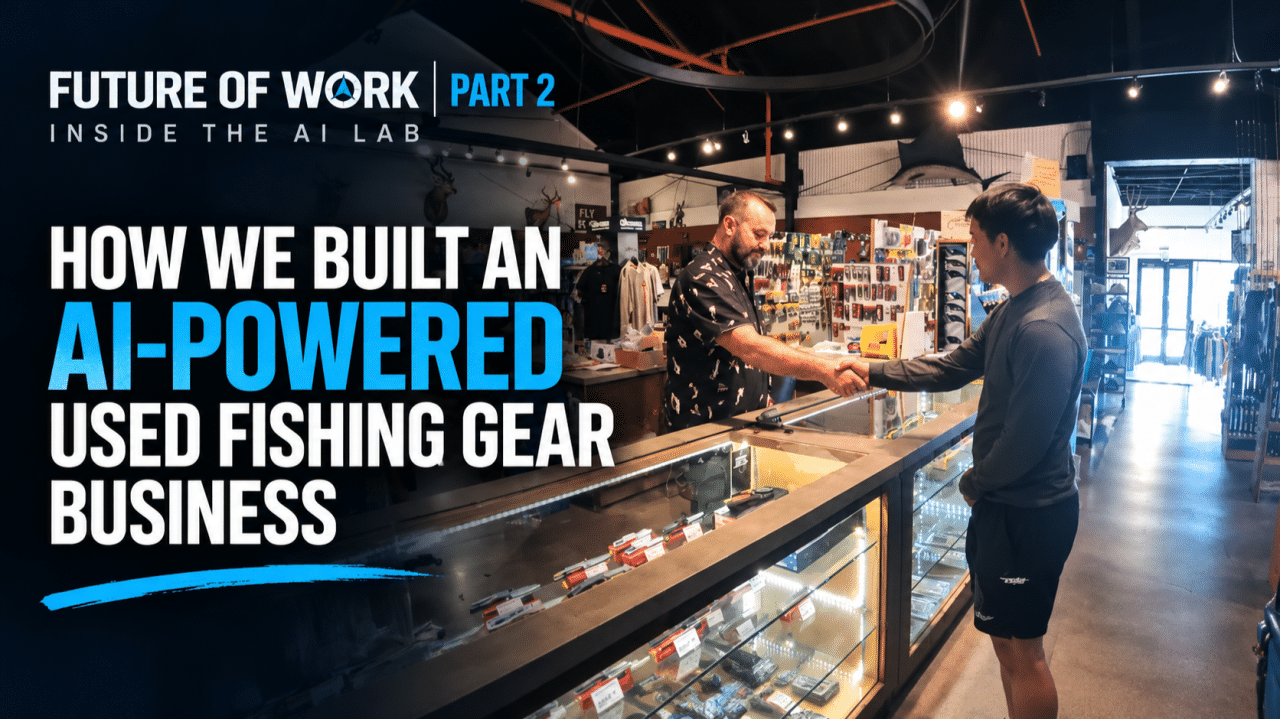
Future of Work, Part 2: How We Built an AI-Powered Used Fishing Gear Business
Pond Stars: Turning unwanted fishing equipment into a new revenue stream with ChatGPT, Codex, and practical automation.
Inside the AI Lab: From Experiment to Execution
In the first article of this series, I introduced an experiment that began in January 2026 at Sweeney’s Sports, a 56-year-old fishing tackle store in Napa, California.
The premise was simple: Could we use AI to save a struggling small business from closure and bring it back to profitability?
As Head of AI Labs at ArchIT and owner of Sweeney’s Sports, I had an opportunity to test this in a real operating business. No hypothetical use cases—just actual customers, employees, inventory, and financial consequences.
In Q3 2026, we reported 21.3% revenue growth compared with the previous year, alongside improving margins and profitability. Multiple factors contributed, including stronger inventory management, customer service, and favorable seasonal demand.
In this series, I’m breaking down the AI workflows we’ve built, examining the results, and sharing what we’ve learned.
First up is Pond Stars, our AI-powered used fishing gear program. It’s an example of how AI can do more than reduce costs. It can make entirely new business opportunities economically viable.
The Opportunity Hiding in People’s Garages
If you’ve been fishing for a while, chances are you’ve accumulated rods and reels you no longer use.
Maybe you inherited a collection. Maybe you’ve switched from bass fishing to salmon or stripers. Or maybe you simply upgraded your equipment.
There’s a healthy secondary market for certain fishing products, particularly high-end reels and collectible equipment. But selling individual items on eBay or Facebook Marketplace takes time, research, negotiation, photography, and shipping.
And shipping a nine-foot fishing rod isn’t exactly straightforward.
We recognized an opportunity: What if customers could turn their unused fishing equipment into cash or store credit toward something they actually wanted?
We first attempted the program about two years ago.
The customer demand existed, but the economics were difficult.
Every item required inspection, market research, valuation, negotiation, product descriptions, categorization, photography, entry into our point-of-sale system, and eventually online listing and fulfillment.
Unlike new merchandise, where we might receive 12 identical reels under one SKU, every used item is a one-of-one product.
The labor was overwhelming. We eventually scaled back the program and accepted mostly larger collections.
The idea was good. Our process wasn’t.
Rebuilding Pond Stars With AI
In early 2026, we revisited the program using ChatGPT and Codex.
Our initial working prototype took days to assemble, but it was far from a finished system.
Over approximately five months, we developed and refined valuation formulas, reusable Codex skills, customer submission tools, API integrations, and operational workflows.
Today, those components connect customer submissions, equipment valuation, demand analysis, negotiation, purchase orders, inventory creation, and website publishing.
Rather than explain this entirely in theoretical terms, I recorded a real customer transaction at Sweeney’s.
Step 1: A Customer Submits Their Collection
Customers visit SweeneysSports.com and use a submission app we built with Codex.
They can submit equipment from their phone or computer, photographing each item, identifying its condition, and indicating whether they’ll bring the collection to the store or ship it.
Our team receives a notification and reviews the submission.
Originally, I wanted to automate the valuation immediately upon submission. We changed that approach to include a human review first. Sometimes photos are unclear, or the collection contains equipment we don’t want to purchase.
Once approved, we initiate the evaluation through a dedicated Codex project.
In the accompanying video, our customer Eduardo brings in a Shimano SLX DC reel and a Daiwa Tatula rod.
Our employee Axel inspects the equipment, photographs both items, and submits the collection through our app.
I then ask Codex to process Eduardo’s collection.
The valuation takes approximately 10 minutes, giving Eduardo time to browse the store while we prepare an offer.
Step 2: AI Valuation and Demand Intelligence
Codex invokes our Pond Stars Submission Evaluator skill and produces two documents.
The first is a customer-facing valuation sheet showing the equipment’s historical or original retail price, estimated current used market value, and proposed offers in cash and store credit.
The second is our internal Demand Pilot, an Excel-based intake document that provides a deeper analysis.
This is where things get interesting.
Our system evaluates incoming merchandise using a proprietary demand score ranging from zero to four.
A score of zero means we should generally decline the item. A four identifies highly desirable equipment we believe could sell within five to seven days.
Between those extremes, the system provides buying guidance based on estimated demand, resale potential, and our historical sales information.
In Eduardo’s case, the Shimano reel receives a demand score of three, while the Tatula rod receives a two.
The internal document also includes estimated resale values, offer guidance, and modeled gross profit.
These aren’t simply generic AI-generated prices. We’ve spent months refining the rules and formulas using our sales history, market research, and experience processing used equipment.
The goal isn’t to buy everything cheaply. It’s to identify equipment our customers actually want and acquire it at a price that makes sense for our business.
Codex makes a recommendation. We make the purchasing decision.
Step 3: Inspection, Negotiation, and a New Sale
With the evaluation complete, Eduardo and I discuss the offer.
We review the equipment’s condition and market value. I explain what we expect to sell the items for and what we can offer.
The final negotiation produces a $145 store-credit offer for both items.
Eduardo accepts.
But the transaction doesn’t end there.
He wants a new striper fishing setup for bank fishing on the Napa River.
We help him select a new rod-and-reel combination, including line, totaling $210.69.
His trade-in credit covers $145 of that purchase, and he pays the difference.
Think about what just happened.
Eduardo converted equipment he no longer wanted into something he was excited to use.
We acquired two pieces of used merchandise to resell, sold a new fishing setup, and strengthened our relationship with an existing customer.
The negotiation and product recommendation were entirely human interactions. AI handled the research and preparation that helped make them possible.
We’ve noticed this pattern repeatedly. Customers receiving store credit often upgrade to more premium equipment, sometimes purchasing 300–600 rod-and-reel combinations.
Based on our preliminary estimates, approximately 70% of our used gear acquisitions are paid through store credit rather than cash.
That’s important to the economics of the program.
Step 4: From Accepted Offer to Online Inventory
Once the transaction is complete, I update the valuation document with the final negotiated prices.
Then I return to the existing Codex task and instruct it to create the purchase order in Lightspeed, our point-of-sale system.
Codex prepares the product records, including descriptions, categories, costs, and retail prices.
Our employees review and receive the purchase order, print the price tags, and check the items into inventory.
That receipt triggers the next stage of our workflow, which publishes the merchandise on our website using the same photographs captured during intake.
No additional photography. No manually recreating product descriptions. No entering the same information into multiple systems.
In the video, you can see Eduardo’s two traded items appear on our website, with their photographs and prices, shortly after we’ve completed the transaction.
This is the part of the process that previously made the entire business model difficult to sustain.
Now, much of that work happens through a connected automation.
We still maintain human checkpoints at inspection, valuation review, negotiation, and inventory receipt. As the system improves, we can choose which additional steps to automate.
The objective isn’t automation for its own sake. It’s reducing the time and labor required to complete each transaction.
The Economics: Why the Model Works
Over hundreds of transactions, we’ve developed margin targets for equipment we acquire.
Cash transactions generally require higher margins because we’re paying money out immediately.
Store credit allows more flexibility because it often leads to additional purchases of new merchandise.
Used equipment also gives us something traditional retail inventory often cannot: a constantly changing assortment.
Customers visit our store and website specifically to see what interesting equipment has arrived.
And that creates another benefit.
Pond Stars: From Inventory Program to Marketing Engine
We’ve turned the intake and negotiation process into a video series called Pond Stars.
We film interesting collections, explain equipment values, demonstrate inspections, and sometimes negotiate on camera.
Some videos attract tens of thousands of views, while others have reached much larger audiences.
People watch because they’re curious about the equipment, the negotiations, and what something might be worth.
That exposure introduces new customers to the business and encourages people with unwanted gear to submit their collections.
More collections create more unique inventory. More inventory creates more content. More content helps attract buyers and sellers.
It’s a cycle that traditional retail merchandise doesn’t easily replicate.
Measuring the Results

In Q3 2026, our in-store used-gear sales reached nearly $14,000—11.2 times the same quarter last year.

Purchases containing used gear averaged $104.85 across the full merchandise basket, compared with $42.76 for purchases without it. Used gear also showed an annualized Q3 turnover rate of 8.62, versus 2.42 for new merchandise. Those inventory figures remain provisional, but they suggest the program combines larger baskets with faster-moving stock.
What Five Months of Development Taught Us
The Pond Stars workflow wasn’t built with one clever prompt.
It required building, testing, making mistakes, adjusting formulas, connecting systems, and processing enough real transactions to understand where the problems were.
We learned that human decision points matter, especially when inspecting equipment and negotiating with customers.
We learned that reducing duplicate work is just as important as automating individual tasks.
And we learned that the most valuable AI applications aren’t necessarily those that completely remove people from the process.
They’re the ones that allow a small team to accomplish something that previously required too much labor to justify.
Two years ago, we already knew there was a market for used fishing equipment.
What we lacked was an efficient way to operate the business.
AI didn’t create the customer demand. It helped remove the operational barriers that prevented us from serving that demand profitably.
That’s the larger lesson from Pond Stars.
And it applies well beyond fishing equipment.
Every industry has processes that are too expensive, repetitive, or complicated to pursue economically. Some of those represent opportunities waiting for a better operating model.
Bringing the AI Lab to Your Business
At ArchIT AI Labs, we’re applying these lessons to help businesses identify, build, and deploy practical AI workflows.
Sweeney’s Sports is our working laboratory. The experiments happen inside a real business, with real financial and operational consequences.
We’ve built Pond Stars into a connected system, but the underlying methods—document processing, valuation, decision support, system integrations, and automated execution—can be applied to many other businesses.
If you’re running a store, a company, an architecture studio, or an operation with complex manual processes, I’d be happy to discuss what we’ve learned and how similar workflows might work for you.
Questions? Get in touch at GetArchIT.com.
Follow the series as we continue exploring real workflows, measurable business results, and how AI is changing the nature of work.