
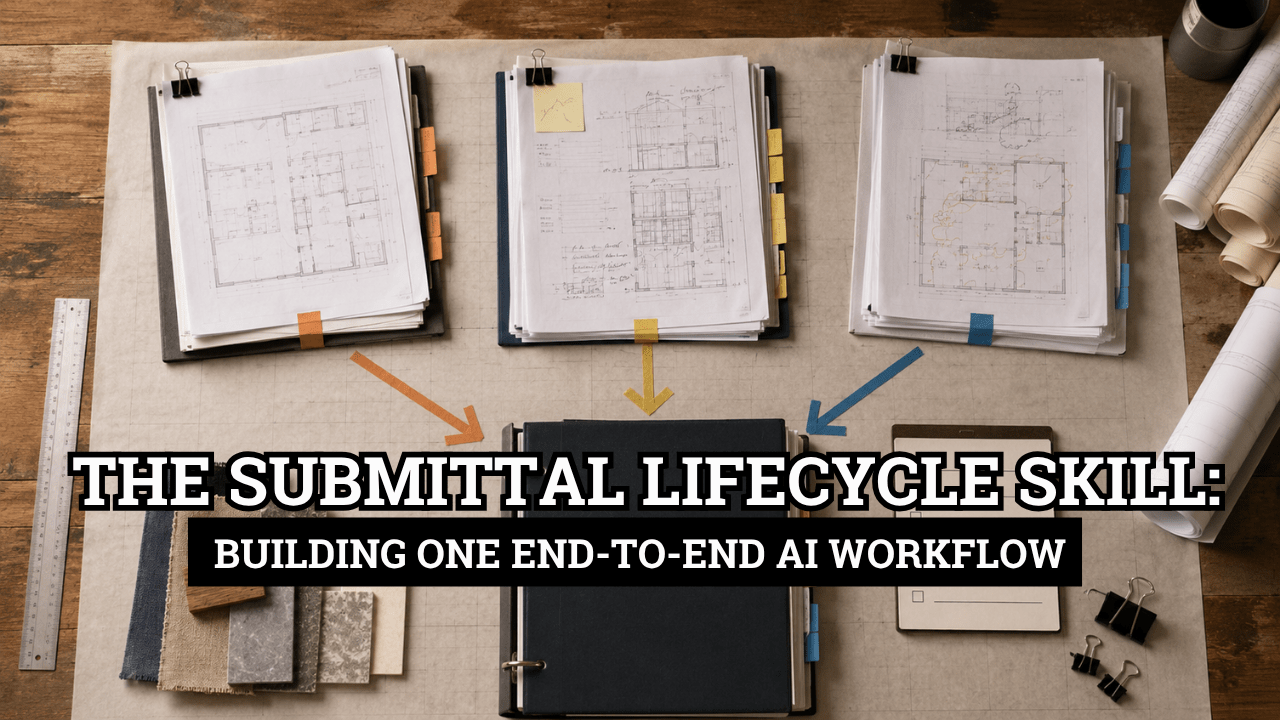
The Submittal Lifecycle Skill: Building One End-to-End AI Workflow
From Three Workflows to One Complete Submittal Lifecycle
Submittals are essential to construction administration, but managing them can consume a significant amount of an architecture firm’s time. Each package must be received, logged, compared against project requirements, reviewed, returned, tracked, and sometimes processed again as a resubmittal. The work demands professional judgment, yet it also includes a large volume of repetitive document handling and data entry.
This creates a strong use case for AI—not as a replacement for the architect, but as a system for preparing information, maintaining records, and moving work between clearly defined human decision points.
Throughout our submittal series, we built and tested three separate AI-assisted workflows:
In this final episode, those workflows are consolidated into one Submittal Lifecycle Skill that can support the process from initial receipt through final resolution.
What the Three Original Skills Were Designed to Do
The first workflow focused on intake. It organized incoming documents, captured the relevant project data, and prepared information for the submittal log. This is an important first step because small errors at intake can affect every later stage of the process.
The second workflow addressed review. AI could organize the package, compare available information, and prepare the review context, but the architect remained responsible for evaluating the submittal and selecting the appropriate response. That separation is critical: AI prepares the work; the professional makes the decision.
The third workflow handled tracking and resubmittals. It determined whether a submittal could be closed or whether another cycle was required, then maintained the status information needed to keep the process moving.
Each workflow was built using mock documents from the same fictional project. After testing each stage, it was exported as a reusable skill. Two skills were created in one AI platform and the third in another, which also demonstrated an important practical point: skills built in a common, portable structure can be moved between compatible AI environments instead of remaining tied to the platform where they were first created.
Combining Separate Skills Into One System
The three exported skills were uploaded into a single project and the AI was asked to merge them into one complete workflow. Instead of simply combining the instructions, the system was also directed to run test cases using the sample submittal files from the series.
This extra validation step mattered. A workflow can appear complete on paper while still containing sequencing problems, unclear exception handling, or conflicting instructions between stages. Testing the consolidated skill against representative documents exposed two meaningful issues.
The Duplicate-Check Ordering Bug
In the intake workflow, the system drafted a new log entry and prepared it for human approval before checking whether the submittal already existed in the log. That sequence could ask a person to approve an entry that should never have been created.
The corrected workflow moves the duplicate check ahead of the approval gate. Now the system verifies whether an existing entry is present before it prepares a new row for review.
This is a small change in sequence, but it illustrates why AI workflows should be tested as operational processes—not treated as static prompt documents.
The Missing-Document Guardrail
The resubmittal workflow contained another ambiguity. It had rules for situations in which supporting information was available but had not yet been checked. It did not clearly address a different situation: the governing document might be missing entirely.
In the test case, a required specification section was unavailable. Without a stronger guardrail, the workflow could not reliably distinguish between an item that appeared to be addressed and one that could not be verified.
The revised skill now flags unavailable source documents explicitly. It does not make a recommendation that depends on evidence the system does not have. This creates a clearer handoff to the human reviewer and reduces the risk of false confidence.
Human Gates Are Part of the Design
The completed lifecycle skill is not intended to approve submittals automatically. Its purpose is to perform the data-heavy work surrounding the decision:
- Organize incoming packages
- Extract and structure relevant information
- Check for duplicate records
- Prepare review context
- Track status and revision history
- Identify missing information
- Package the output after approval
At defined points, the workflow stops and waits for human review. The architect remains responsible for the professional evaluation, the final response, and the outcome of the submittal.
This division of labor is one of the most useful principles for implementing AI in architecture firms. Repetitive processing can be automated or accelerated, while professional accountability remains with the people qualified to exercise it.
A Practical Rollout Path for Architecture Firms
The consolidated skill is ready for experimentation, but it should not be connected immediately to a fully automated production process. A safer and more useful rollout begins with supervised, manual use.
Start by processing four or five real submittals through the skill. Review every output and note where the workflow differs from your firm’s established procedures. Refine terminology, approval points, required fields, folder conventions, and exception rules until the skill reflects how your team actually works.
Once the workflow performs consistently, connectors and scheduled processes can be introduced gradually. A mature implementation could eventually:
- Receive new submittal packages from a project-management system
- Prepare standardized intake records
- Route packages to the appropriate reviewer
- Maintain a dashboard of active items and current stages
- Track response deadlines and resubmittal loops
- Preserve a clear record of human approvals
The dashboard becomes the operational view for the construction-administration team, while the skill performs much of the repetitive preparation behind it.
The Real Value: Consistency, Focus, and Better Control
Submittal processing involves many documents, details, and interruptions. Even experienced staff can lose time moving information between files, logs, emails, and project systems. AI is well suited to this high-volume coordination work when its responsibilities are clearly bounded.
The value of the Submittal Lifecycle Skill is not that it removes people from the process. It creates a repeatable structure around them. The system handles routine data work, identifies exceptions, and pauses at the points where professional judgment is required.
By merging intake, review, tracking, and resubmittals into one tested lifecycle, an architecture firm can begin building a more consistent construction-administration process—one that reduces administrative effort without surrendering oversight.
The Submittal Lifecycle Skill is available as a free resource from ArchIT. Firms can use it as a starting point, test it with their own documents, and adapt it to their internal procedures before introducing deeper integrations or automation.
If you have questions or need help please reach out to us.
ArchIT specializes in providing IT services for architecture, design, and engineering firms.