
Around the Fire: An Honest Conversation About AI and the Future of Architecture
At the Monterey Design Conference, an informal gathering of architects turned into one of the most memorable conversations of our weekend.
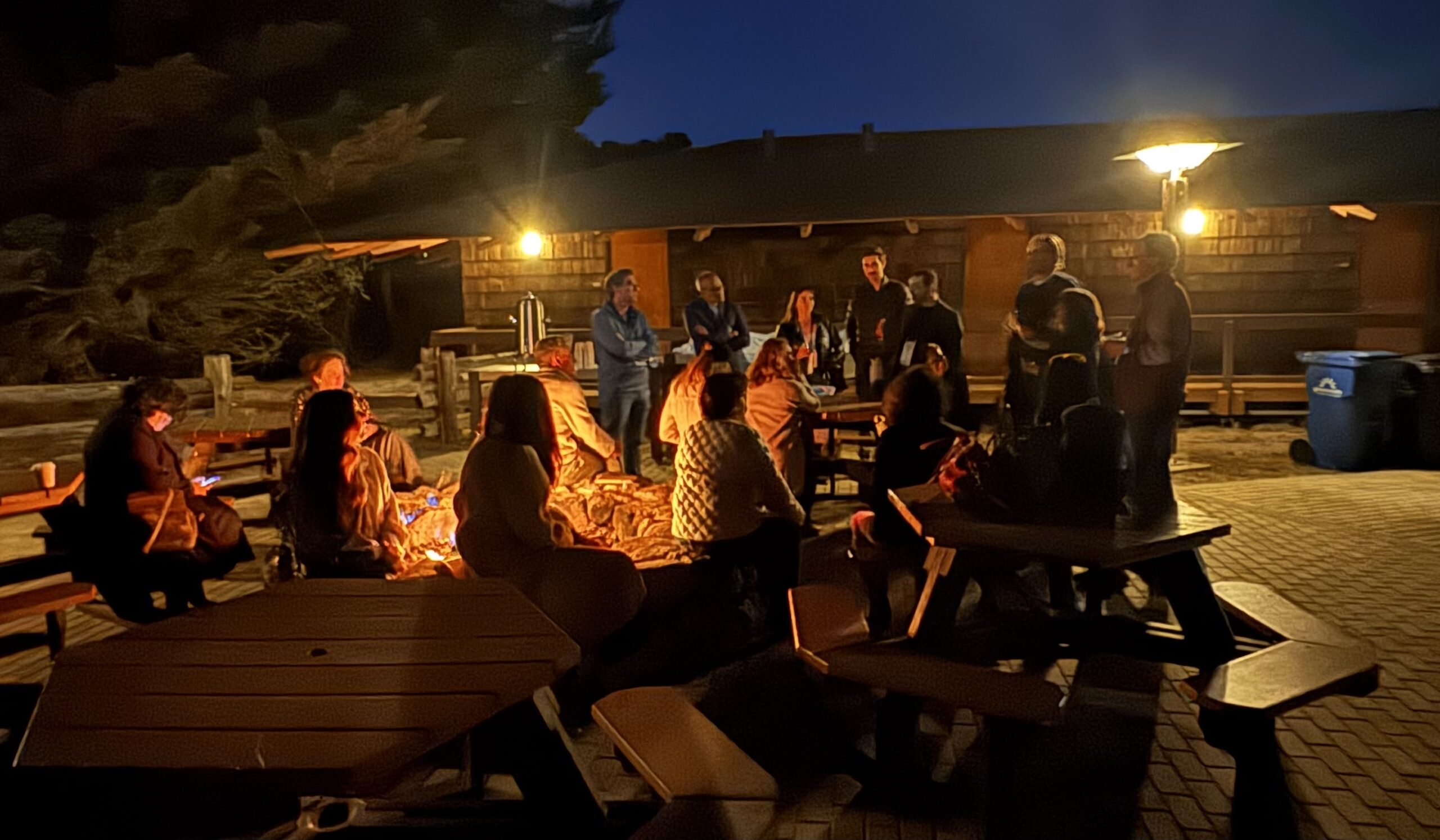
It was a beautiful Monterey evening. The air was crisp, the Pacific Ocean murmured somewhere beyond the trees, and a glowing fire pit illuminated a handful of empty tables.
I sat there alone, surrounded by a few bottles of wine, wondering if anyone would show up.
My colleague Boris had disappeared in search of a corkscrew we’d forgotten. Dinner had run late, the conference schedule had been full, and our little gathering wasn’t part of the official program.
For a moment, I thought it might just be the two of us enjoying wine by the fire. I couldn’t have been more wrong.
An Idea Born at the Monterey Design Conference
ArchIT has been a longtime exhibitor at the Monterey Design Conference (MDC), one of our favorite gatherings of the architecture community.
This year’s conference brought together approximately 900 attendees from some of the most creative, accomplished, and distinctive architecture practices. The presentations were inspiring, the conversations engaging, and the setting, as always, spectacular.
As the conference’s only technology vendor, ArchIT occupies an interesting place in this community. We don’t design buildings. We provide the technology infrastructure, support, and expertise that help architecture, engineering, and design firms do their best work.
We’ve built our business around these professionals, and over the years, we’ve come to appreciate not only their technical challenges but also their creativity, curiosity, and remarkable dedication to their craft.
This year, however, there was another subject I was eager to explore:
Artificial intelligence.
AI has become a significant focus of our work at ArchIT. As Head of AI Labs, I’ve been experimenting with ways to integrate this technology into real business operations, moving beyond demonstrations and clever prompts toward practical, measurable results.
But I wanted to hear from architects themselves.
Were they experimenting? Were they skeptical? Excited? Worried? How far had they progressed, and what did they imagine the next few years might bring?
So Boris and I organized an informal AI in Architecture meetup, scheduled for Saturday evening after dinner, around an outdoor fire pit.
No slides. No presentations. Just architects, a little wine, and an open conversation about the future.
The Question That Started Everything
Back at the fire pit, just as I was beginning to question our timing, a woman we’d met earlier at the ArchIT booth approached and sat down.
We started talking, and almost immediately, she posed a question that would define the evening:
“What happens to us architects as this AI technology begins to improve and get better and better?”
Behind all the excitement surrounding AI lies a very real uncertainty about the future of professional work. What happens to the skills we’ve spent decades developing? What happens to young people just entering the profession? And what becomes of creativity when machines can increasingly perform tasks that once required years of training?
I began offering a historical perspective, drawing parallels with earlier technological revolutions. Then, about five minutes into our conversation, people started arriving.
First a few, then a dozen or more almost at once. Soon the tables were full and our intimate little gathering had grown to more than 25 architects. I asked the woman to repeat her question for everyone.
What followed was not a debate with winners and losers, but something far more interesting: a candid exchange among professionals who shared a passion for architecture while holding strikingly different views of its future.
The Wisdom of Experience, the Anxiety of Youth
Several younger architects spoke openly about their concerns.
Some wondered whether their jobs might exist in a few years. If AI could generate drawings, manipulate models, and increasingly participate in design, where would that leave the next generation of architects?
Their unease was understandable. Then an older architecture principal, a gentleman who appeared to be in his late sixties or seventies, offered a compelling perspective.
He had lived through extraordinary technological change and reminded the group that every major transformation had challenged established assumptions about work.
The Industrial Revolution reshaped entire economies. Computers transformed professional practice. The internet changed how businesses operated, collaborated, and competed.
Each disruption displaced familiar ways of working, but also opened doors that hadn’t existed before.
His central point was simple and powerful: Technology changes the tools and the nature of work, but human creativity, experience, and professional judgment remain essential.
I was impressed by the wisdom of his response. He wasn’t dismissing the concerns of younger professionals or suggesting that everything would remain unchanged.
Quite the opposite.
He understood that profound change was coming, but viewed it through the lens of someone who had already witnessed several reinventions of the profession.
Around that fire, two generations were looking at the same future. One saw uncertainty and potential loss. The other saw transformation and opportunity. Neither perspective was without merit.
A Glimpse of What Is Already Possible
Then another architect shared an experience that brought the conversation from speculation into the present.
She was already using AI in ways many professionals are only beginning to imagine.
She had connected Claude, Anthropic’s AI assistant, to Autodesk Revit, allowing her to interact with her design environment in a fundamentally different way.
Instead of relying exclusively on the traditional sequence of menus, clicks, commands, and repetitive modeling operations, she was using AI to help execute significant portions of her work.
The design remained hers. The creative decisions remained hers. But the mechanics of turning those ideas into finished models had changed.
Her approach resonated with me because it closely resembled what Boris and I have been exploring in our own AI Lab: giving AI access to the actual tools and workflows of a business, rather than treating it as an isolated chatbot.
The most remarkable part of her story, however, wasn’t technical: It was economic.
Her small firm, consisting of just four or five people, was taking on work that would traditionally demand substantially larger teams. And her practice was growing.
Consider the contrast.
Only minutes earlier, we had heard young professionals wondering whether AI would take away their livelihoods.
Now we were listening to an architect explain how the same technology was helping a small practice expand its capabilities and compete far beyond its traditional weight class.
Could AI become the great equalizer for smaller architecture firms?
Could a highly capable team of five compete with a firm of twenty? Could expertise, creativity, and intelligent use of technology become more important than sheer organizational size?
For firms that have spent years struggling to recruit enough talent, manage growing workloads, or compete with larger competitors, these possibilities are worth exploring.
And here was someone already doing it.
Innovation, Responsibility, and the Price of Progress
As the evening continued, another architect raised an entirely different concern, he was ambitious, enthusiastic about AI, and actively embracing it in his practice. But he was also deeply troubled by its environmental impact.
AI requires enormous computational resources, and the infrastructure supporting it consumes substantial energy and water. As adoption accelerates, so do legitimate questions about sustainability.
He wanted his team to remain conscious of that cost.
One idea he described was installing a meter at each workstation to make energy consumption more visible and encourage employees to think about the environmental consequences of their work.
His commitment was genuine, and I admired it, but I challenged him: What happens when a young architect, fresh out of college, joins your team?
Should that person feel guilty about experimenting with AI? Would visible consumption metrics discourage someone from exploring an idea, making mistakes, or discovering something unexpected?
Would we risk placing a psychological price on curiosity? His answer was thoughtful.
Perhaps, he suggested, that young architect should first walk over to a more experienced colleague, strike up a conversation by the watercooler, and learn from someone who had spent decades solving design problems.
Not every question needs to be answered by a machine. That response stayed with me.
Our exchange wasn’t really about electricity meters or AI tokens. It was about finding the right balance between technological progress, environmental responsibility, and human connection.
And he raised something we should be careful not to lose in our enthusiasm for AI: the extraordinary value of learning from one another.
I’ve invited him to join me on our Design Under Influence podcast, where I hope we can explore these ideas in greater depth.
What I Took Away From Monterey
As the evening wound down, I found myself reflecting on the remarkable range of perspectives we’d heard.
A young generation anxious about its place in the profession, an experienced principal who had seen enough history to recognize transformation rather than simply fear it, an innovative young architect demonstrating how AI could allow a small practice to accomplish extraordinary things, and an environmentally conscious professional reminding us that progress comes with responsibilities we shouldn’t ignore.
Nobody had all the answers. Certainly not me. But perhaps that was the most valuable part of the evening.
For all the predictions about what AI will or won’t do, its future in architecture is still being shaped by the people who use it, question it, challenge it, and push its boundaries.
At ArchIT, we spend our days helping architecture firms navigate technology. Through our AI Lab, we’re learning firsthand how quickly the possibilities are expanding.
But evenings like this remind me that the conversation cannot be only about technology.
It’s about people, their ambitions, their fears, their creativity, and the future of a profession that shapes the world around us.
To everyone who joined us around the fire, thank you for your openness, your curiosity, and your willingness to share. And to everyone we met at the Monterey Design Conference, thank you for another memorable gathering.
I hope this was only the beginning of a much larger conversation.
Until we meet again, around another fire or across another conference table, let’s keep challenging assumptions, sharing what we learn, and exploring what’s possible.
— Alex Osenenko
Head of AI Labs, ArchIT
Host, Design Under Influence