
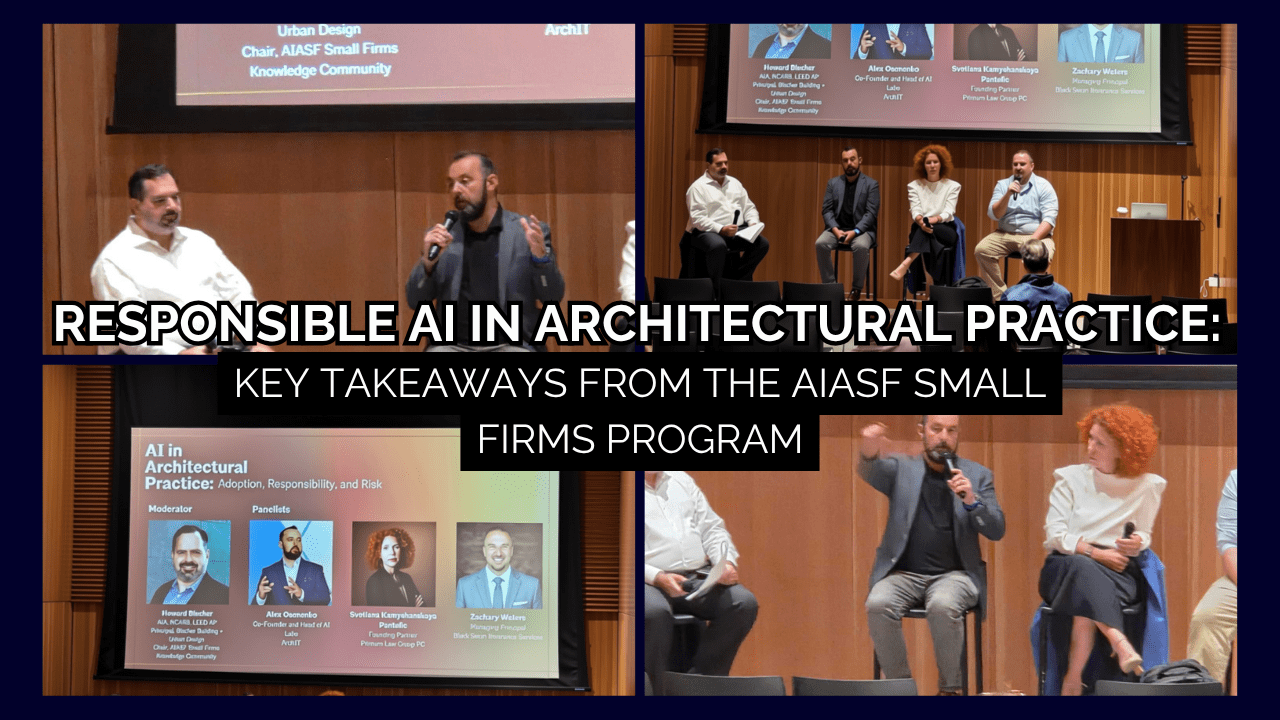
Responsible AI in Architectural Practice: Key Takeaways from the AIASF Small Firms Program
Artificial intelligence is becoming part of everyday architectural practice, supporting research, correspondence, proposals, design exploration, documentation, and firm operations. As these tools become more capable, firms must also consider security, confidentiality, professional responsibility, and client trust.
These topics were discussed during AI in Architectural Practice: Adoption, Responsibility, and Risk, an AIASF Small Firms program held on August 25, 2026, at the Center for Architecture + Design in San Francisco.
Alex Osenenko, Co-Founder and Head of AI Labs at ArchIT, participated as a panelist and shared practical guidance for architecture firms exploring AI.
Creating a Responsible AI Policy
One of the central takeaways was that firms should establish an internal AI policy before introducing the technology across their operations.
Alex outlined three essential components:
- Approved tools: Employees should know which business-grade AI platforms they are permitted to use.
- Data classification: Firms must define what information is public, internal, company-confidential, client-confidential, or personally identifiable.
- Human responsibility: AI can assist with the work, but a qualified professional remains responsible for every final deliverable.
An AI policy should not prevent experimentation. It should create a safe framework that allows employees to explore the technology without exposing the firm or its clients to unnecessary risk.
AI and Professional Judgment
The discussion distinguished between using AI for early design inspiration and relying on it to produce final architectural work.
AI can help generate ideas, organize precedents, and explore conceptual directions. However, current systems may not reliably understand complex drawings, technical conditions, or the complete context of an architectural project.
Architects should therefore review and verify all AI-assisted work. The technology can support professional judgment, but it cannot replace the architect’s responsibility or standard of care.
Begin With Administrative Workflows
Some of AI’s strongest immediate opportunities may exist outside design.
Architecture firms can use AI to support proposals, research, meeting notes, internal documentation, business operations, and construction administration. For example, AI-assisted workflows can help organize submittal packages, track revisions, identify missing information, and prepare materials for review.
These systems should reduce repetitive work while preserving clear human approval points.
Enterprise, Desktop, and Local AI Tools
The panel also explored different ways firms can implement AI.
Business-grade platforms can offer stronger administrative and data-protection controls than personal accounts. Desktop applications can go beyond answering questions by working with approved files, folders, and connected business systems.
Local AI models may eventually provide firms with greater control over information and recurring costs. However, firms should first test and refine a workflow using established tools before investing in a more complex local system.
Regardless of the platform, firms should evaluate how information is stored, processed, retained, and used.
Start With the Workflow, Not the Tool
Before selecting an AI platform, firms should identify the process they want to improve:
- What problem are we trying to solve?
- What information will the AI receive?
- Does the process involve confidential data?
- What should the system produce?
- Who will review and approve the output?
- How will the work be documented?
This workflow-based approach helps firms focus on practical value instead of adopting technology simply because it is new.
Moving Toward Secure AI Adoption
Responsible AI adoption is an ongoing process. Firms should regularly review their policies, approved platforms, security controls, employee training, and AI-assisted workflows as the technology evolves.
Thank you to everyone who attended the AIASF program, asked thoughtful questions, and contributed to this important conversation.
If you have questions or need help please reach out to us.
ArchIT specializes in providing IT services for architecture, design, and engineering firms.